Ode to
Instant Ramen
Over the years, I’ve had many revelatory food experiences. There’s the rare ribeye at the restaurant in the North End where my sister likes to drag me after a tough week, where she never even lets me see the bill because it would break my brain. There’s the sushi at Sugar Fish in LA, where they don’t even put soy sauce on the table so you can’t tamper with the impossible creamy freshness of the sustainably sourced salmon with its scoop of perfectly cooked rice. There’s my mom’s Filipino food, which despite her claims that she’s not a real cook, is actually heartier and more flavorful than anyone else’s Filipino food anywhere, and would make her millions if she would just take my advice and open a restaurant called Mom’s Meryenda.
But none of it has ever come close to supplanting the food that for me has always represented the pinnacle of bliss: beef-flavored Nissin Top Ramen.
One of my earliest memories is of the clink of the white cereal bowl (the only kind of bowl we owned) as my mom placed it on the table in front of me. I would lean forward and nuzzle my face into the heavenly pillar of steam rising from the deep amber colored broth, where sharply crimped noodles drifted under the iridescent shimmer of grease. I would dip in my fork and try to raise each bundle of carby wires to my mouth without letting it fall apart, enjoying the sting of the hot tines and the resistance of the chewy noodles. Then I would drink the scalding broth down to the last drop, and go lie down somewhere to sweat.
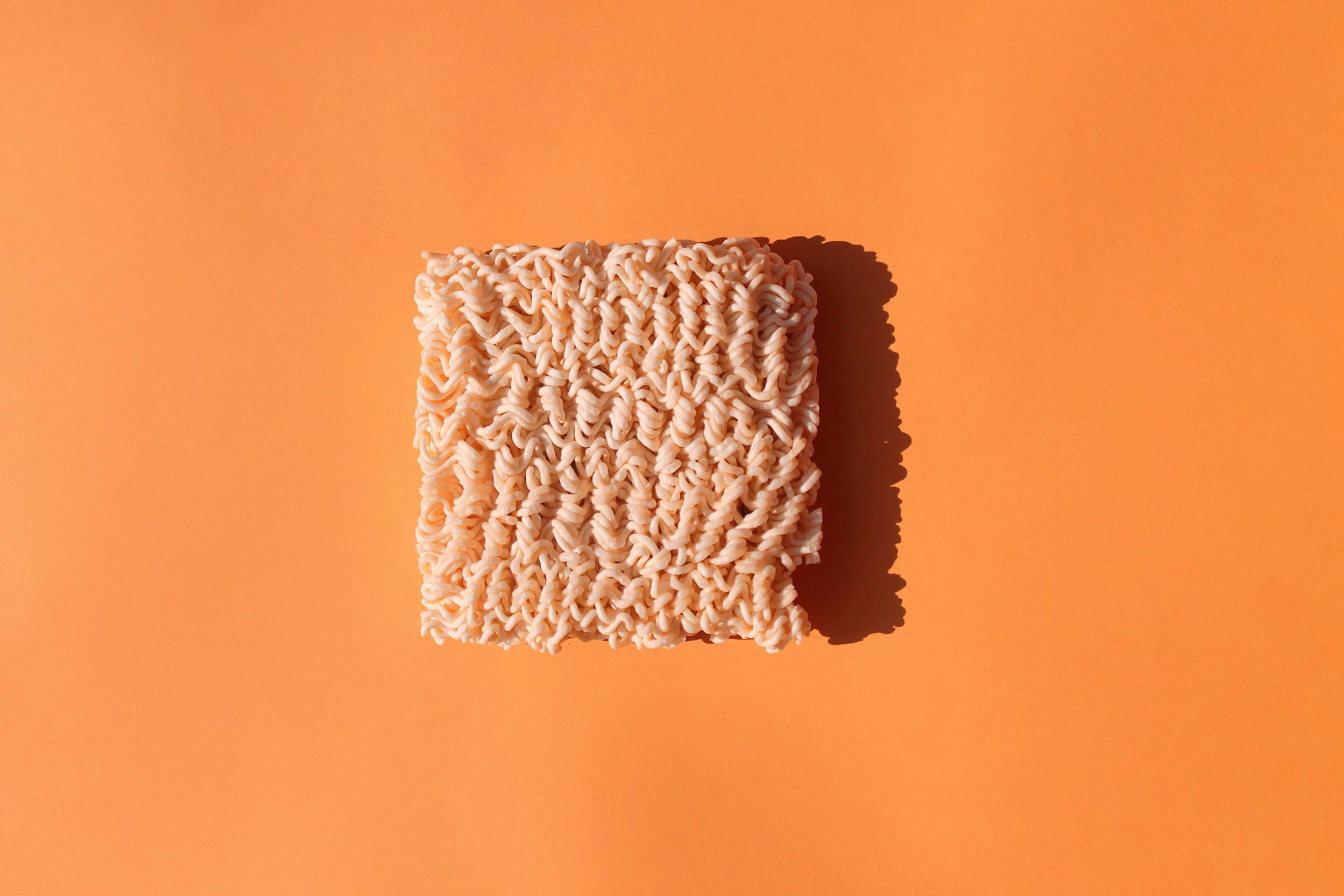
It was the first food I made for myself. I would fill the saucepan with water to the exact right level—too much and the broth would be a tasteless light gold; too little and your tongue would shrivel in its dark saltiness and die. I would turn up the gas burner to eight (there was only one speed at which to make ramen, which was as fast as possible). I would take hold of the compact brick in its familiar red and white packaging, pinch the flimsy plastic in the fingers of each hand, and pull the end of the package apart, revealing pale waves of densely packed noodles. Reverently, I would reach in and remove the silver flavor packet, running my finger along its serrated edge and pinching the slight, tantalizing thickness of its contents through the foil.
As the water boiled, I would break the brick crosswise and lengthwise, enjoying the sharp snap of the dry noodles. I would turn the package upside down over the pot and watch the four thick squares slide into the water and bob on the surface. I would hover, fork at the ready, and at a strategic point I would reach in and stab and shake each square with a force carefully calibrated to unwind the noodle bundles partially, but not all the way. I would shake the flavor packet to settle its contents at the bottom, rip off the top of the foil square (carefully, so as not to lose a single grain), inhale the impossibly mouth-watering aroma that wafted forth, and upend the packet over the pot, turning it into a boiling brown brew. Quickly, so as not to burn myself, I would swish the packet in the water, to get any stray grains that had stuck in the corners.
Finally I would stand back, hand on the dial, watching for that magical moment after the crunchiness of the noodles had been boiled away, but before terminal softness set in. It was a window of only a few seconds, and I identified it solely by gut feeling, wrist twisting suddenly to shut off the burner before I had consciously decided it was time.
There was only one way to eat ramen, which was within seconds of coming off the stove. If you waited any longer, the broth would lose the just-short-of-unbearable heat level that seemed to be an essential part of its flavor, and the noodles would lose their perfect zigzag shape and firm texture, becoming limp and bloated like dead worms.
I always read when I ate ramen. I loved being ensconced behind a propped-book at the kitchen counter, or curled up in the corner of the couch with the bowl balanced on the arm. If I didn’t happen to be reading something at the time, I would go running madly through the house to find a book, any book—even if I’d read it hundreds of times. And if anyone interrupted my reading and eating, I would snap like an animal defending its kill until they retreated.
My ramen time was sacred. It was the cure for hunger, boredom, cold mornings, and rainy days. As I got older, ramen was a means to procrastinate growing piles of homework, and a reliable way to run into family members wandering through the kitchen without admitting you were lonely. Its simple steps gave me a sense of control over my destiny. Its salty caress soothed restlessness, frustration, jealousy, and broken-heartedness. When things went wrong, gazing into the depths of the boiling broth would make them right again, if only for a few minutes.
My college dorm didn’t have a stove. So instead I broke the noodles into small chunks, stuffed them into my plastic thermos, filled it to the brim, and stuck it in the microwave. The result was crunchier and more concentrated than ideal, but as long as it scorched my throat on the way down, all was well. I expanded my palette to cup soup—I enjoyed peeling off the paper lid, pouring boiling water up to the line etched in the Styrofoam, and removing the steamed-up saran wrap minutes later to reveal tantalizingly wiry noodles—but the broth was lacking. Neoguri was an infusion of zest into my instant soup game, with its rakish red and black packaging, its udon-thick noodles never losing their sharp curls, its fiery orange broth and even more fiery, eye-watering spiciness. But nothing ever felt like home as much as good old Nissin Top Ramen.
When I moved back home the year after college, my mom would unfailingly turn up at the sounds of running water and the clatter of cookware. She would turn down the burner and I would turn it up again. She would ask for half, and I would tell her to cook her own. She’d chatter despite my stony silence, reach over with her fork and fish noodles out of my bowl. I would fly into a fury and cook another pot, and she’d get huffy and reject my charity, but then later the soup would be gone. When I moved out, this was one of the things I missed the most.
Living on my own for the first time, ramen became a means of experimenting as I transitioned to real cooking—cracking an egg on the edge of the pot and watching the yolk swirl like molten gold, throwing in cabbage or bok choi. It became the end to a night of drinking with the reporters—stumbling in the door, clumsily lighting the stove, scarfing the noodles straight down, and sighing as they hit my stomach, steadying me like a seasick sailor who has found land.
It became my go-to dish for guests, even if they never seemed to appreciate it as much as I did. “It tastes like jet fuel,” one boyfriend complained. Another introduced me to what he called actual ramen, taking me to a little shop where we sat at a counter and slurped enormous bowls of rich broth and thick noodles with pork slices and tea-stained soft-boiled eggs. “Oh yeah, it’s so much better,” I assured him, because the bowls were twenty dollars. But it was like watching a movie and wishing the whole time you were reading the book—the real thing.
It was only well into my twenties, as I earned my graduate certificate in nutrition science at Tufts’ Friedman School of Nutrition Science and Policy, that I came to fully appreciate just how bad instant ramen is for you. In addition to its load of highly processed and refined carbs, bleached of fiber and nutrients, that tiny package contains a whopping 1800 milligrams of sodium, almost an entire day’s recommended intake; 6 grams of saturated fat; the flavor enhancer monosodium glutamate, whose side effects include heart palpitations and burning sensations in the face and neck; and the preservative tertiary-butyl hydroquinone, a petroleum industry byproduct. Slowly, I have cut Nissin Ramen from my diet, replacing it with homemade chicken broth, vegetable stews, and soba noodles.
But then, early last year, when the pandemic broke out and the lines at grocery stores stretched around the block and everyone started binge-buying old comfort foods, I decided it had been long enough. From one of the rare online stores that wasn’t sold out, I ordered a whole 24-pack of Nissin Top Ramen. And as I tore open that crinkly package once more and saw those perfect rows of noodles, I experienced that certainty that comes with even the cheapest and unhealthiest of beloved foods—that although you may no longer be the child who first ate it with such wonder, and although everything may have changed beyond recognition, the moment you bring that first bite to your lips you’ll be home again, and all will be right with the world.