Total Eclipse
of the Heart
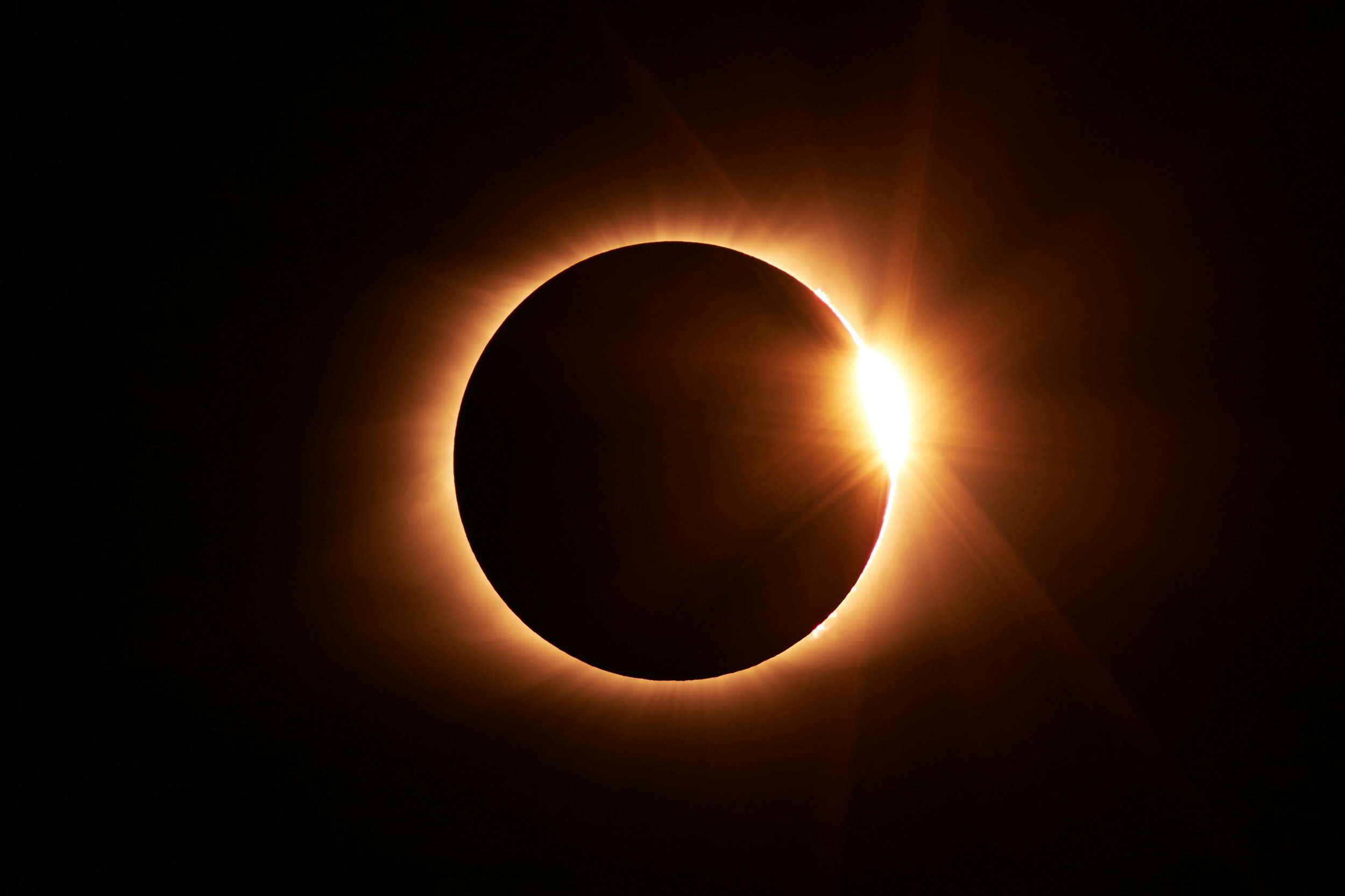
“You should go see the path of totality,” my dad told me a few months ago.
He meant, as you may know if you’ve been alive and online these past six months, the path where you can see the moon completely block the sun during the total solar eclipse this Monday, April 8.
My dad is a diehard science nerd and physics Ph.D. who drove nine hours from San Francisco to northern Oregon into the path of totality during the last total eclipse on August 21, 2017. Last October, he drove five hours to southern Oregon for the annular eclipse, chasing a non-cloudy viewing spot, then drove home (he had work the next day)
My response to him was, “Meh.”
I love the arts; my dad is more interested in quantum computing. On nighttime walks, when I’m secretly hoping for the heart-to-heart we haven’t had since he moved to the other coast, my dad will be busy listing every phase of the moon. I’m a cautious driver—my dad, on the other hand, once crossed three lanes of traffic to a McDonald’s in half a second because my sister said, “I want French fries.”
Googling “path of totality traffic,” I found horror stories of hours-long gridlock on middle-of-nowhere roads just after the 2017 event, and 2024 volume predictions equally bad. Airbnb rentals in the zone of full darkness started at $500 a night, and one two-star motel was charging $2,000 for a weekend eclipse package.
“93 percent is more than enough,” I told myself (that’s how total the eclipse will be in Boston).
Then a week ago, I found a last remaining semi-affordable cabin in northern New Hampshire right at the edge of the coveted band, and hit “Book now.” I’ll be picking up my free pair of limited-edition, ISO-certified solar eclipse glasses today at Warby Parker.
Why? Partly it’s this urge I still have from my days as a local reporter, to be right there on the spot when something big is happening. Partly there’s something thrilling about the challenge of beating crazy traffic, and being a little bit impulsive.
Partly I’ve been thinking that while I’ll likely be around for the next total solar eclipse viewable from North America in 2044, my dad might not—and that if he can cross three lanes of traffic to get one of his daughters French fries, and list every phase of the moon to break the awkward silence with the other, I can make a short hop north so we can text about something that matters to him.
Totality will hit my dad in Dallas at 1:40 p.m. ET for three minutes, and me a little less than two hours later for 40 seconds. But we’ll be watching the same thing happen in the same sky. I guess a total eclipse is more than just a historical event or a celestial event 238,900 miles away. It’s a moment of wonder that aligns us even across great distances, and a reminder that writers and scientists, dads and daughters, and all of us down here on Earth have more in common than we think.